Showing posts with label Book Reviews. Show all posts

Monday, February 16, 2015

Book Review: The Defense of the Faith

Cornelius Van Til, The Defense of the Faith, 1st ed. 1955, 4th ed., K. Scott Oliphint editor. P&R Publishers, 2008.

I haven’t done a book review in a while. It’s not that I haven’t been reading. It’s just that I haven’t read much that merited me to share my thoughts. I’m still not sure that Van Til’s book The Defense of theFaith meets that qualification, but alas here I am anyways.

Van Til is known as the father of presuppositional apologetics. He argues that his method is THE reformed apologetic that is most consistent with Scripture and Calvin himself. A bit of backstory: Van Til left Calvin College perhaps in large part due to controversy stirred up with his apologetical method. He then took up a tenure at Westminster Theological Seminary and flourished. His ardent students who have followed in his footsteps are the late Greg Bahnsen and John Frame.

I would be lying if I told you that this book was great. I’m not a philosopher and my theological chops are not all that sharp as a result. My area of expertise is NT studies, biblical theology, and the NT's use of the OT. Apologetically, my area of “expertise” would be biblical studies related. I can handle Ehrman. I don’t know what to do with Kant. Be that as it may, Van Til laid out quite eloquently (read: philosophical jargon that flew high over my head) his methodology for a consistently reformed apologetic. It goes something like this. 

First, there can be no neutral ground between believers and non-believers. We all interpret nature, being, and knowledge based on our presuppositions for good or for bad. However, since we are all created and bear the image of God because of God’s common grace, there is a sense of divinity [sensus divinitatis because Latin makes it better!] wherein we all have some knowledge of God. The difference between the believer and the unbeliever is that the sinner suppresses that truth (Rom. 1:18ff.) and opts to believe in autonomy rather than acknowledge subservience to the Creator. What this looks like then is that a Christian can offer all the proof or evidence in the world to an unbeliever. But the unbeliever will simply interpret it based on his presupposition of autonomy. The error, among others as Van Til points out, is that the non-believer has no way to account for fact or logic so as to interpret nature or reality or being and so on. That is not to say that the unbeliever cannot know something. However, they can only know because they have access to the only way we can know anything – the sensus divinitatis. But because they deny their knowledge of God and suppress it, they cannot account for how they know anything. This makes the non-believer function in the realm of both a rational and irrational epistemology. They can rationally use logic to know something, but they believe everything is left to chance which can only lead to irrationality (what they know can just as simply change). However, the believer can account for knowledge because not only does he acknowledge the sensus divinitatis, but God has determined everything in the counsel of his will and thus knows everything. Only that which he ordained can happen. Thus God has an absolute knowledge. There is no chance with God. And God has revealed himself partly in the sensus divinitatis. Therefore knowledge is accessible and accountable for believers. When non-Christians know something and declare they know something, they are actually borrowing from the Christian worldview or tapping into the truth of God that they so deeply try to suppress.Therefore, the only way to account for anything, much less knowledge or reality or facts, is through the Christian (and reformed) worldview. Or to put it another way, Bahnsen said, "[T]he proof of the Christian God is the impossibility of the contrary."

Even as I type this out, I feel like I do not completely understand or have the ability to explain Van Til. I almost certainly need to re-read it, and sooner the better. However, I have encountered modern presuppositional apologists and have been quite impressed with their argumentation. Perhaps the best example of this method in action is Greg Bahnsen’s debate against Gordon Stein the atheist. He totally destroys him. It is definitely worth the listen.

As for the book, Van Til is dealing with a lot of issues. But more than anything, he is not just arguing for a methodology, he is arguing, or better defending his methodology from his peers who have completely trashed him. It got quite tiresome having to read how so-and-so got it wrong or misquoted or misrepresented or misunderstood his views. Conversely, I found the philosophical approach and the presuppositional method quite engaging. I have taught a low level form of it in my 10th grade class the past 2 years. But I still teach a classical approach as well. But Van Til does an extraordinary job explaining why his method is thoroughly reformed and thus biblical. I want/need to read more by others who can speak to me on my level.

With that in mind, I can’t say at all why this book was in my High School library! But I am delighted it was. But I can only give it one thumb up since it is a read beyond me. Perhaps this just means I need to improve my philosophy and metaphysical theology more.

Friday, May 24, 2013

The Theology of the Book of Revelation - Book Review

I have nearly completed all of my assigned reading for my upcoming Revelation class. I wanted to do one more book review, albeit a shorter one, on Richard Bauckam's The Theology of the Book of Revelation.  If there was one book that treated this subject better and yet more concisely than Bauckham, then I wouldn't believe it.  This book is a treasure of information.  There is nearly a quotable portion on every page.  My highlighter eventually ran out of ink on this one.  I did resist the urge to post them on facebook just because I knew I would have to change it every 5 minutes.  Two thumbs up for the serious student to scholar!

PS-this book has spurred me to read more Bauckham.  I am looking forward to reading his larger collected works on Revelation The Climax of Prophecy. 

Tuesday, April 16, 2013

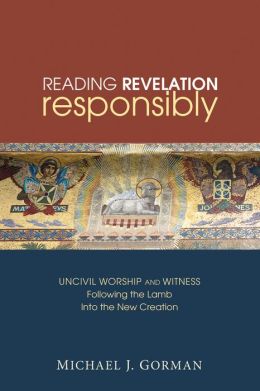
Reading Revelation Responsibly - Book Review

Gorman, Michael J.  Reading Revelation Responsibly: Uncivil Worship and Witness: Following the Lamb into the New Creation. Cascade Books, an imprint of Wipf and Stock Publishers, 2011.

Since I am taking a class on the book of Revelation this summer, I have to read a host of books on the Apocalypse.  I am not too deep into my reading, but for a monthly book review, I wanted to mention the last book I just finished.  It was very good, very practical, and very insightful.  Gorman's Reading Revelation Responsibly gives an outstanding approach to Revelation.

Here is a basic overview.  Gorman is primarily arguing from the idealist interpretation of Revelation.  Although he does see certain visions pointing back to the Roman empire, by and large the book is timeless (and missional).  The more I read, the more I see a prevailing view in modern interpretation of Revelation that says it is not so much an encouragement for those being persecuted as it is a warning or prompt to non-conformity to the empirical cult of the day.  It is a work of apocalyptic to encourage believers of Jesus, the slaughtered Lamb, to be anti-assimilation from the empire.  Gorman treats that very practically for American evangelicals who have pretty much divinized patriotism and turned it into a civil religion itself.  Thus, the way he reads Revelation  has a great relevance for the American Christian church for today, who have as much if not more loyalty to a nation and its cultic-civil practices as for loyalty to the Lamb.  If we were honest, this is indeed the situation in many churches in USA (just observe many services on or around the 4th of July in the Bible belt).

Gorman also sees Revelation to be very missional, which I appreciate.  Since the community of Christ is a multi-ethnic and global community, patriotism to one nation makes little sense, especially since we are part of God's empire/kingdom and no longer citizens of this world (Phil. 3:20-21). 

What I appreciate is that his view of empire and the call for believers to come out of the worship of that empire (for example: Christian's swearing fidelity to even the flag of a nation).  No matter the goodness or badness of the empire, conformity should be to the suffering Lamb not to the conquering nation.  Perhaps his greatest insight is how the mission is accomplished through non-violent action.  In other words, Jesus conquers not with the sword in his hand but the sword in his mouth (through his word).  He wins by dying.  The lion king overcomes by being the slaughtered lamb.  And the mission of the church is to overcome injustice in the same way.  We don't take up the sword ("for God and country") to win the day.  We stand apart from the empire with dying to self, bearing our own cross, and suffering for the sake of Jesus.  It is when we are comfortable in the empire we live in that is the true danger for the churches to repent of.

Perhaps a major flaw is that his politics do seem to creep in to his critique of what an (bad?) empire is, America being the prime example.  It seems that the capitalistic and nationalistic society of America has encouraged the empire of America which leads to injustice on all levels and social categories.  Whether he is correct in that assessment is not for me to decide here.  But there is a negativity towards those systems, something I am not altogether comfortable with.  Every political agenda is flawed (communist, socialist, or capitalist) because it is a system of sinful humans.

Lastly, Gorman is very critical of the dispensational, futurist view.  He critiques it repeatedly throughout the book (most especially the Left Behind series).  Let me say that I am in full agreement with his critique.  However, knowing the fundamentalist, dispensational mindset very well, many who would normally give Gorman a fair hearing will completely turn him off with the over-critical nature in his presentation.  Has the futurist view terribly distorted the meaning of Revelation and thus the political practices of many in the church???  YES!  But I wonder if his constant barrage of the futurist view is helpful to win the argument.  However, I feel confident that his concern was not to win an argument, so I may be offering a moot point. 

In all, this brief presentation of a responsible way to read Revelation gets 2 thumbs up from me.  It is a simple and short book for all sorts of readers (student to scholar).  It is presented well and full of practical insights that make it tremendously valuable in seeing Revelation as a vital part of the churches devotional, spiritual, missional, worshipful life.

Wednesday, March 20, 2013

The Jesus Legend - Book Review

Paul Rhodes Eddy & Gregory A. Boyd, The Jesus Legend: A Case for the Historical Reliability of the Synoptic Jesus Tradition, Grand Rapids: Baker Academic, 2007.

I'm not entirely sure what prompted me to read The Jesus Legend, and I'm not even certain I am glad I did.  Ok, that is a lie.  I am thrilled I read this book.  It has equipped me in an area of research that I am fairly weak in. 

TJL is not necessarily an apologetic arguing for the historicity of the resurrection or something like that.  Rather, it is a refutation of the Jesus-legend movement that is still prevelant today answering and rebutting their many claims and arguments against the historical reliability of the synoptic gospels.  More specifically, it was a book on methodological issues in regards to inquiry into quest for the the historical Jesus.  More aptly, this book is in all reality a treatise on how not to quest!

One of the things that stuck out to me in this book was the depth and breadth of research that it engaged.  Without getting too specific, issues of memory, orality, and a wide host of other issues were well documented and thoroughly treated from a vast host of other inter-related disciplines. 

I also appreciated the authors' emphasis on seeing the gospels as stemming from an orally dominate culture as well as probably being a result of oral performance (explains many of the differences, dare I say contradictions, in the gospels).  It made the idea of redaction criticism seem a bit unnecessary in light of this.  However, the authors do see a need to harmonize in some way or shape to recreate the historical event.  I don't necessarily disagree with this, but I am more interested in the text when doing theology.  But alas, this book was a sketch on historicity. 

Eddy and Boyd pretty much ripped apart form criticism in this book as well (sorry Bultmann), spending 2 chapters debunking and defuncting their views.  At times this section was slow and tedious, but it paid its dividends in the end.  They also set up the book very nicely with the introductory chapter arguing for an open historical-critical method.  I found this section to be quite engaging and well argued.

Conversely, one of the chapters answering the claim that Paul was not aware (or didn't care) of the Jesus tradition and thus created Christianity was, in my opinion, not well argued.  This is not to say that they were wrong, only that I do not think it was their strongest chapter.  Aside from that and a non-existent closing or summary (it ends rather abruptly), I predict this book will be a standard text book in seminary.  Heaven only knows why it was in my high-school library, but I'm not complaining. It gave me a chance to read it!

I would caution certain people about reading this book because (1) it is… advanced is not the right word… but you know what I mean.  It is not a simplified or dumbed down version of the debate.  It was scholarly.  It assumed a prior knowledge (or at least soon to be acquired knowledge) in the field of NT research and the historical Jesus debate.  (2) Though most of what is said is helpful, those with a fundamentalist view of scripture along with a strict adherence to inerrancy will have a problem with some of the book's ideas about how the gospels work as a genre and historical testimony, especially when those testimonial witnesses seems to conflict with one another (something we actually want in eye-witness testimony to avoid the appearance of forgery).  Other than that, I recommend this book fully for anyone wanting to enter the fray of questing (are we on the 3rd???).  It is a well written and thorough treatment defeating the arguments posed by critics and arguing that the synoptic gospels truly are historically reliable, or at least the burden of proof is on the critic to make the case that they are not.


Tuesday, February 19, 2013

A New Testament Biblical Theology - Book Review


Considering my less than favorable review of G. K. Beale's Handbook on the New Testament Use of the Old Testament, I felt I should follow it up with his stupendous work, A New Testament Biblical Theology.  Let me say up front that I whole-heartedly agree with Thomas Schreiner's review on the back cover calling this book Beale's "magnum opus."  This work represents years of research from a fantastic teaching and writing career.  Beale has captured his thoughts from creatively reading Scripture (especially intertextuality of OT in the NT) and unloaded them into this tome. 

First the good points (to name only a few).  Where do I begin?  I think Beale has unfolded a method of not just doing NT theology but rather NT biblical theology, an important distinction that needs to be emphasized (cf. "Intorduction" for more details about the distinction).  Beale sees the storyline of kingdom, new creation, covenant and other major themes carried over, continued, and retold in the NT.  What I appreciated is his emphasis not on a theological or thematic center throughout the Bible but rather multiple themes that when woven together make a plotline or storyline of Scripture. 

The subtitle of this book states much of Beale's theology and methodology: "The unfolding of the Old Testament in the New."  What I would call good biblical theology must be done this way.  Unfortunately, systematic theology lacks in this process, usually allowing the NT to supersede or unfold the OT.  I think John Sailhamer was dead on the mark when he said, “The Old Testament sheds a great deal of light on the New Testament. Our primary objective should be to read the New Testament in light of the Old Testament, not vice versa.”  This is exactly what Beale does.  Even though this book is called A New Testament Biblical Theology, it could rightly be considered a "whole-Bible" approach with more space or emphasis on the NT than the OT.  But he never addressed a biblical theological theme in the NT without first examining and developing it in light of the OT storyline (and even in 2nd temple Judaism).  And much of the way Beale interacts with the OT in the NT demonstrates how this unfolding of the OT in the NT is so vital.  Thus I stand by my statement that Beale is, in my opinion, a virtuoso in doing theology and relating the OT in the NT rather than explaining how to do it or giving his methodology as in his Handbook. 

Thirdly, I think his emphasis on new creation and kingdom brings to light how the NT picks up and continues the storyline of the OT.  One thing I felt lacking, however, was an appeal to the theme of covenant in that storyline.  For example, there is one major difference between Beale's OT storyline versus the one he offers for the NT which is to be a continuation of the OT's plot.  The OT storyline is, "The Old Testament is the story of God, who progressively reestablishes his new-creational kingdom out of chaos over a sinful people by his word and Spirit through promise, covenant, and redemption, resulting in worldwide commission to the faithful to advance this kingdom and judgment (defeat and exile) for the unfaithful, unto his glory."  Then he went on to give the NT storyline that continues the OT's, "Jesus's life, trials, death for sinners, and especially resurrection by the Spirit have launched the fulfillment of the eschatological already—not yet new-creational reign, bestowed by grace through faith and resulting in worldwide commission to the faithful to advance this new-creational reign and resulting in judgment for the unbelieving, unto the triune God's glory" (both definitions found on p. 16).  Where is "covenant" in the NT's "transformation" of the OT plotline???  Also, the latter definition mentions "unto the triune God's glory," however Beale failed to make this point in his theology.  Why the emphasis on the "triune God" I wonder?  Nevertheless, Beale does make mention of covenant throughout in the NT storyline.  I just would have liked to see it in his definition of the NT storyline.   Regardless of these matters, these definitions help to keep the storyline of the OT and NT in proper focus.

The other criticism I have is that though he tries to avoid thematic or theological "centers", he nevertheless falls back on the theme of new creation and kingdom (linked) repeatedly with the already/not yet thrown in the mix.  I would argue that by extension, this is for Beale the center of the theology of the Bible.  Others, like Schreiner and Craig Blomberg, mention Beale's emphasis on new creation in their blurbs on the back page.  So others are seeing this as well.  This is not necessarily a big issue, except it seems to be in conflict with what he explained at the outset (and in ch. 6).

Perhaps a major inconsistency of a minor issue concerning the outworking of Beale's theology is his view of the Sabbath changing from Saturday to Sunday (ch. 23) in contrast with baptism unchanging from circumcision for infants (p. 815-816).  If applied to the baptism/circumcision issue, his arguments for the Sabbath changing days would negate completely his paedo-baptism view.  Nevertheless, this view of baptism was hardly a focus of the book, and so I cannot be overly critical here because it was mentioned more or less in passing.

One final pro and con: parts of this book were fleshing out of Beale's biblical theology that has never been seen or elaborated on before.  Other parts, however, were rehashings and revisions of many of his previous works.  For example, many occasions the footnotes were references to other works he had already done in greater detail on the issues.  Thus at times I was riveted at Beale's thoughts.  Some chapters were so outstanding, that I had to re-read them (i.e. chs. 2-6 or Part 1 of this book was all about Beale's whole-Bible theology).  Other times, I was bored since it was simply a condensed version of what he has written previously (that I had read).  To demonstrate this further, if you ever need a bibliography for Beale's writings, you can find it on pg. 964-965, since he cited nearly all of his previous works in NTBT.  Yet at the very least he is taking all of his research and putting it into a well arranged theology.

This book is outstanding and receives 2 thumbs way up!  Those wanting to study biblical theology, NT theology, and/or especially NT biblical theology need to soak this volume up like a sponge.  It is a long book eclipsing the 1,000 page mark, but it reads rather quickly.  Its audience is from the lay person who is serious about theology or the student on up to the scholar (he stated as much on p. 25). 

Tuesday, January 15, 2013

Handbook on the New Testament Use of the Old Testament -- Book Review

It has been said that those who can’t, teach.  I wonder if the opposite is true, even in a small way; that those who can, can’t teach (teach well?).  I am a huge fan of G. K. Beale for 2 reasons: he is a biblical theologian par excellence & his understanding and exegesis of the NT use of the OT is second to none.  However, in his recently published Handbook on the NT use of the OT, I felt that it was a bit wanting in this subject area.  Don’t get me wrong, for what it is (a broad yet brief introduction to the subject), it is good.  But I think Beale’s forte is more about doing than explaining his method for doing (the latter being the topic of this book). 

My research inquiries of late have been on this subject (mainly how salt and light were OT symbols evoked by Jesus  in Matt. 5:13-16 and the significance of the Shema in James 2:19; both need more work before I consider them “publishable”).  So I had high hopes for this book.  And that could be the cause for my less than positive review here. 

The most beneficial part of this book is that it lays out Beale’s method to study the NT’s use of the OT.  If there was a person’s exegetical methodology to emulate, it would be Beale’s.  He raises questions that interpreters need to be asking themselves when dealing with this part of exegesis and theology.  He unfolds a 9 step process for examination.  But some of these steps were either very obvious (step #1 and identifying the quotation or allusion), or could have used more clarification (step #9 and the rhetorical use of the OT), or overlapped with other steps (Steps #5 & #6; comparing the texts in the LXX, DSS, MT, OG, and Jewish sources with analyzing the author’s textual use of the OT or Steps #6 & #7; comparing the author’s interpretive/hermeneutical use with his theological use).

2 very helpful areas of Beale’s Handbook are his emphasis on 2nd temple Literature (something I have been critical of in the past but now see the importance of such a study) wherein he devotes an entire chapter to this subject (though parts were extremely wearisome to read through since there was a lot of bibliographic info) and his list with examples of multiple ways the NT uses the OT.  However this section was much too brief to really illustrate the various ways and give the reader a high level of clarity.  And even then, there was overlap between categories (something Beale himself admitted) which proved to be somewhat unhelpful.

The intended audience is certainly for students being introduced to this important subject.  As Beale stated in the preface, “The purpose of this book is to provide pastors, students, and other serious readers of Scripture with a how-to approach for interpreting the use of the OT in the NT.”  So it is definitely a 101.  However, it does cite bibliographic info that will help in the research process.  Therefore, it does have some “replay” value in that regard.

Perhaps its biggest fault in my estimation is that it was not well written.  I have to be careful here because I’m not Bill Shakespeare by any stretch.  But as I said above, I believe Beale’s strong suite is to do rather than to teach method.  There were times where the book felt tedious.  Now I must be honest and say that the tedium of this book is that it may be a consequence that it was an intro level book.  But there was something that left this realm of research something less to be desired.  I expected in an intro level book from an author such as Beale to motivate those interested in this realm of study to see the tremendous pay out of a detailed study.  The examples he gave hardly raise the excitement level, in my opinion. 

When I compare the helpfulness of this book to, say, his and Carson’s Commentary on the NT Use of the OT (they edited the book and authored some of its chapters) or Beale’s magnum opus A New Testament Biblical Theology where we see his method in action (and the return it yields in theology), I feel that this addendum did not meet the expectations of the other 2 works.  Thus I only give this book 1 thumb up.  After all, it did give a thorough working model for one of the greatest biblical theologians and exegetes of OT in the NT of the 20th-21st century.  It will be a necessary tool for the student engaging with this subject for the first time or a pastor refreshing his mind with the subject for preaching and teaching (and offering a good method to evaluate these instances of OT in the NT).  And I think its strengths stop there in that it will not go beyond an introduction or helpful refresher.  Even as a textbook to a class on the NT’s use of the OT, I feel it would have to be supplemented with other books where there is more of an emphasis on doing rather than explaining method (something such as Hearing the Old Testament in the New Testament).


Tuesday, December 11, 2012

Dominion and Dynasty - Book Review

Stephen G. Dempster, Dominion and Dynasty: A Theology of the Hebrew Bible, IVP Academic, 276 pgs.

I praise the Lord that God has surrounded me with thinkers who have influenced me positively towards a better understanding of the Old Testament.  This is important for myself who is specializing in the field of New Testament studies.  Thank you, Todd and Stephen, for being that OT influence on me and encouraging me to read in this field and this book.

I just recently finished Dominion and Dynasty: A Theologyof the Hebrew Bible by Stephen Dempster.  This book was a biblical theology of the OT that focused on genealogy and geography or "scion and Zion" in the OT.  Or to say it another way, it focused on a place for God to dwell with his people – a dominion and dynasty. 

One of the many advantages of this book is that it treats the Tanakh as a Text rather than composed of 22 separate texts.  He interprets the OT (and really the Bible) as a whole book with interlocking themes and intertextual links.  Such a view is really where I am theologically and interpretively in Scripture.  With my next reading venture to approach narrative theology, this book is a great example of treating the Bible as a single book telling a single, overarching story.  There is great interpretive value in that.

I am also currently, however very slowly, reading through Pentateuch as Narrative by John Sailhamer.  This book is a brief commentary on the Torah (the "t" of TaNaKh) which reads the 5 books as one Text.  It brings continuity and cohesion to Genesis through Deuteronomy.  Dominion and Dynasty is similar to that, except it has a wider scope of the entire OT and not just the Pentateuch.  Yet it is smaller or more focused than Drama of Scripture which puts the entire story of the Bible on display as one Text.  And so you can determine if this book would be a good fit for you as you read the Bible as a Text or single story. 

The value of this book as that its presentation was concise and simple.  Yet the writer did an excellent job bringing out Hebrew punning and wordplays that clearly and intentionally drew the reader's attention to some of the most defining themes of the Tanakh.  I wish I had read this a month ago when I was doing the OT section of my Sunday School lesson of the Bible as one story.  It is that helpful for making sense out of the OT.  This is much needed today not only for the impact that the OT story has on the NT, but mainly because most modern Christians only see the OT as moral examples and pithy lessons on what or what not to do, along with great Psalms and Proverbs thrown in the mix.  (But many are not sure what to do with the prophets outside of a few obvious passages.)  This book will develop a Christian's theology of the OT like few other books can.

The downside I have with this book is that while I appreciate emphasizing the Hebrew canonical order, and even how that order teaches theological truths, I felt that Dempster could have spent more time developing his canonical methodology and deal with issues like (1) why the order is what it is and (2) give a more theological understanding of inspiration as it relates to canonical ordering.  What I mean is, the 2 Hebrew Bibles that I own display the Tanakh in a slightly different order than Dempster's.  (I know many Christians are not even aware that the Christian OT is not a proper ordering of the books).  Dempster moved Isaiah after Ezekiel rather than leading off the latter prophets (which makes better chronological sense) and Ruth to the beginning of the writings rather than after Proverbs (linking the woman in Prov. 31 with the example of Ruth).  These minor changes do make a difference in the story that Dempster is telling, though not a great deal of difference.  I would have liked him to explain his canonical ordering in more detail rather than just leaving it to a brief footnote.

Also, since this kind of thinking for many Christians is extremely novel, perhaps a bit more about how ordering books in a certain way has a theological value that adds, dare I say, divine revelation to the story of the Text.  That means that inspiration was not a definite point but a process for the OT.  I have a feeling Dempster intentionally avoided blazing that trail, although I would have liked to see him touch on it for those of us not engulfed in OT theological issues like canon formation and ordering. 

Aside from that, this book receives a hardy 2 thumbs up from me.  Student, scholar, pastor, or laymen alike should read this for its informative value on the theology of the OT.

Monday, December 3, 2012

The Challenge of Jesus - Book Review

For a long time, Jesus-research has been divided as either a historical pursuit or a theological one solely.  Things like the Jesus seminar and the “quest” for the historical Jesus has been much about de-mythologizing Jesus or un-theologizing him.  Then again, when theologians responded with their theological replies, it tended to miss the point of the gospels of the Bible (asking it questions it never was meant to answer) and misinterpret history altogether.

One thing that draws me to N. T. Wright as a scholar is that he is both a judicious historian and a sharp theologian.  In his book The Challenge of Jesus, Wright skillfully intertwines both as he presents a strong case for re-evaluating common notions of Jesus from a historical perspective allowing that to shape our theology.  Christians often read the gospel accounts as theological treatises to answer questions posed by skeptics (i.e. “Is there a god?  If so, who is he?” to which Christians replied “Jesus is God.” which is a response that the accounts weren’t intended to provide).  This book will help inform them as to Jesus’ place in the narrative of Scripture.  On the other hand, skeptics and historians (aka “questers”) have a difficult time giving credence to the gospel accounts scenario of events along with 2nd temple Judaism.  They run the risk of presenting Jesus in a completely unacceptable fashion for Christians to accept.  Thus you have the great divide.

What is most remarkable is that Wright does this on a laymen’s level in this book.  However, I’ve read many other books by Wright wherein he repeats much of the same things at different depths and levels.  For example, he covers in a very brief manner some of the most important points brought out in his Origins of Christianity series.  And he later re-emphasizes some of these points in one of his latest books, How God Became King.  So there is a lot of overlap in regards to Wright and his presentation to Jesus.  Each one is great, but it is not necessary to read all of them to have an adequate understanding of his views. 

I would recommend starting with Challenge  if you want to enter the fray.  If your interest in this kind of presentation to Jesus is piqued, then move on to some of his other books.  If you are really wanting to be challenged by Wright’s writings, then move on to his Origins series.  Ironically, I read him in the exact opposite order to what I am recommending.  So I’d like to think that if read the way I am encouraging, you will only increase in your understanding of his presentation instead of continually reading summations of them as I did. 

Either way, I highly recommend this book as a good distillation (the word my pastor used to describe this book) of Wright’s understanding of the Israel story and Jesus’ relationship to it.  Wright will increase your understanding of the Bible’s grand narrative and its great continuity between the testaments.  It will make sense from a historical perspective why Jesus was executed.  You will see how his actions were meant to be seen as highly symbolic reinterpretation of the OT Israel story played out in the final Exodus of God’s people.  I encourage readers of all levels to read this as an introduction to Wright.  I am assuming most in the scholarly field have already been exposed to Wright, so I would encourage you to read it as a synopsis of what you know of Wright already.  No matter what, read it!

Monday, October 1, 2012

John Piper's Sermons on Romans

For my morning reading, I decided that a good "quiet time" would be to read a sermon a day through Piper's exposition through Romans. (Cf. the tab above "What Tim is Reading" if you are interested in what else I am stimulating my cerbral cortex with)

 If you know me, you know I can't stand "devotionals" that are shallow, short, and shamefully lacking theological value (pretty much all of them!). What I love about this is that it is sermons from one of the 20th centuries greatest preachers (of course he is still preaching). So it is loaded with the practical value that many desire for a quiet time devotional. But it also has the great value of John Piper's insights into Romans (perhaps the most important book in the NT). Oh how I wish he would do a commentary on the book (cf. my review on his short commentary book on Rom. 9).

 The major downside is that sermons don't always communicate most effectively through manuscript. But if you have heard Piper preach at all, you can picture and hear his words in your mind. All in all, this series is excellent and highly recommended for Christians wanting to dive into God's Word and be challenged by it at the same time.  Double thumbs up for a "quiet time devotional" (we need to change these lame cliche titles for this)!!!

Wednesday, June 6, 2012

The Justification of God

I just had the enjoyment of finishing John Piper's The Justificationof God: An Exegetical & Theological Study of Romans 9:1-23.  Let me say 2 things off gate to start this little review.  First, it was really good.  I felt like Piper left very few stones unturned and masterfully handled difficult exegetical issues in as academically honest tone as possible.  Which leads to my second "thing": I was not expecting the depth of analysis that was provided!  This book is not for slouches, least of all Greek slouches.  It is primarily an exegetical commentary of the Greek text of Romans 9:1-23.  I was not ready for that, although I tremendously appreciated that.


Some of this book's strengths are felt immediately once the reality that this little 220 page book is an exegetical force to be reckoned with (granted the print was small).  First, much of it interacted not only with English writers but also German scholarship as well.  This is only fitting and expected since Piper did his doctorate in Germany.   But this exposure beyond American Evangelicalism is always good and extremely important.  Piper also demonstrated various views and fairly presented them to the reader.  I am able to say "fairly" (as in justly or accurately) because I used to hold to the view he was arguing against.  He spent pages demonstrating the opposing views points and arguments.  They even seemed convincing, that is until he destroyed them with his own points and arguments.

Every strength has its weaknesses, however.  Piper's book is no different.  Although it was central to his argument and established what the "righteousness of God" is in Romans, chapters 6-8 take a detour to build a case for his meaning of the phrase "righteousness of God."  This was necessary to establish his point, but it did seem a bit taxing at times.  It gave the book a sense of discontinuity that I felt would have strengthened his view. 

Perhaps another weakness (or this could simply be my mistake) is that I was expecting a more "lay-level" explanation of Romans 9:1-23.  Instead, what I got was a fantastic exposition of the Greek text.  Piper didn't even supply translation or transliteration most of the time.  So for those whose Greek (and Hebrew at times) needs improvement, it is challenging.  This in turn limits the range of audience for which this book will be useful.  Could someone with no knowledge of Greek and Hebrew read this?  Yes, but it would be very difficult. 

Lastly, Piper's conclusions are not real popular; at least they are not popular where I'm from.  But I am glad he was willing to demonstrate and undergird them with solid exegetical support.  The basic premise is that Romans 9 is dealing with individual election unto salvation.  If that is the case, then what should we do with phrases like the following:

"I will have mercy on whom I have mercy, and I will have compassion on whom I have compassion,"
"So then he has mercy on whomever he wills, and he hardens whomever he wills,"
"Has the potter no right over the clay, to make out of the same lump one vessel for honorable use and another for dishonorable use,"
"What if God, desiring to show his wrath and to make known his power, has endured with much patience vessels of wrath prepared for destruction"?

Piper advocates reprobation also known as the unfortunately titled doctrine of "double predestination."  This view sees God as the ultimate sovereign power of the universe.  And yes, he creates some for honor and some for destruction.  I would have liked Piper to develop that a bit more, but he mainly just cites Daniel Fuller who basically says that this is not unrighteous for God to do since the only way to express his great mercy is for people to see and desire it out of his wrath.  This gives the word "grace" an entirely new meaning.

I hope for our sake that Piper, with his upcoming transition from the pastoral ministry to a teaching/writing ministry, will be commissioned by a publisher to write an entire commentary on Romans that will match the intensity and depth that The Justification of God reached (a commentary would also update this now almost 30-year-old book).  This one was fantastic – 2 thumbs way up.  It has a limited readership, but its usefulness for the study of Romans 9 cannot be denied. 

Friday, April 13, 2012

Vacation Reading #2

The 2nd book I read while over vacation was one that my pastor urged me to read (I picked from his library We Become What We Worship).  It was not on my list, and I had no intention of adding a book on hermeneutics and ethics to my list (by the way, the book I am talking about says nothing about hermeneutics and ethics in the title... that was a surprise... a pleasant one too).  I will say this for Stephen Jenks; he has good taste. 

The book that was chosen for me was Four Views on Moving Beyond the Bible to Theology (part of Zondervan's counterpoint series).  Let me preface that the theme of "moving beyond the Bible" has grown a great deal in evangelicalism.  But many (including myself prior) have no idea what that means.  At first glance, it seems that it is a movement away from Sola Scriptura and the foundation of the Bible for all faith and practice.  But actually, it really deals with 2 things: doctrines or practices not explicit but implied in the Bible (Trinity or churches gathering on Sunday's) & ethics or moral theology (slavery was a hot issue in this book).  The Bible has things to say on these subjects, but we Christians have moved beyond the Bible to formulate and systematize them into statements and practices that are only implied or inferred from the text of Scripture (with some philosophical and exegetical gymnastics thrown in the mix). 

There were 4 views presented, with replies from each of the writers, and ended with 3 other perspectives of the theme.  My big problem with this book is that there seemed to be more interaction going on and less explanation of the 4 views presented in the book.  The "reflections" part of the book was an excursus I could have done without.  Not that the added thoughts were bad, but they turned the book into 7 views instead of 4.

Without going into too much detail of all 4 views, let me briefly say that Kaiser's principlizing view is the most widely practiced today.  Even the other 3 contributors principlize.  In other words, we look at a passage like "You shall not muzzle an ox when it treads out the grain," and we see that Paul used this text as a principle to argue that missionaries and elders had a right to be paid for their ministry.  Kaiser was Kaiser every time: short, succinct, and to the point.  Doriani's approach is a popular one amongst the reformed camp (redemptive-historical).  I thought his article was pretty good, but his responses seemed he had an axe to grind towards Webb.

Vanhoozer was amazing, of course.  What I liked most about Vanhoozer is that in his responses, he often made mention of how he'd hoped the discussion would dive into the realm of theology rather than just ethics.  However, when he ventured into theology and ethics, his own theodrama view was hardly applied.  But his approach is probably the most applicable since we, the followers of Jesus, are players and not the audience in the drama of God's kingdom.  This is where Vanhoozer and Doriani are diferent.  Both focus on the redemptive story, but Vanhoozer has us as part of that story (Acts 29ish).  Doriani's approach is one of observation, albeit watching a good, Christocentric story.

Webb was refreshing in that he was tackling issues that many of us shy away from.  His approach is giving him a lot of heat, but he answers honestly and cogently (and a good writer to boot).  I enjoyed his approach.  It caused me to really seek out its validity since it answers many of the hard questions.  To briefly explain (but hardly to justice to his approach), it portrays Scripture as on a trajectory or moving toward a "redemptive spirit".  For instance, the OT and NT never does away with slavery, but the trajectory of slavery as set forth in Scripture (the principle first in the OT then in the NT) is that slavery should be done away with.  He moved beyond the Bible by coming up with an ethic that the Bible never denounced; an ethic that says slavery should be abolished.  I see some major problems with it, but by and large I think he may be on to something (whatever that "something" is). 

I was disappointed that most of this book wrestled with issues like egalitarianism, slavery, and other hot-button issues of moral theology (or slight ecclesiology).  The title of the book was moving beyond the Bible to theology.  This rarely happened, with exception to Vanhoozer for the most part.  It was also mostly a treatment of how we contextualize the Bible to our modern day.  In short, it was a hermeneutical issue.  Things like war ethics ("taking the hot woman" as spoil) or slavery as presented in the OT and NT were mostly discussed.  How can we, as clearly more civilized than the ANEers, use the ethics presented in the pages of Scripture and apply them to our modern world?  Take spanking.  Even those who principlize or see a static ethic presented in the OT (rod of discipline as it is put) still soften the meaning of the text and thus use a trajectory (Webb's view) toward a redemptive spirit of the Bible.

All in all, this put an important issue to the forefront of my mind and forced me to wrestle with my own approach.  This is a good thing!  I am indebted to my pastor for urging me to read it.  In fact, we would all do well to read this book, though it is more for those who are able to critically think about the Bible, theology, hermeneutics, and ethics.  I would recommend this book for any to read, but with reservations for some who are not able to think beyond objectivity and fundamentalism (my axe I grind).  This issue is big, on an apologetics level too.  Since Christians clearly do not stone their rebellious children but rather practice "grace", we have moved beyond the Bible and acquired our own parenting ethic when the NT never explicitly said so.  What is the guide that we follow to move beyond the Bible biblically?  This book enters that debate.  Go forth and do likewise!

Tuesday, April 10, 2012

Vacation Reading

While on vacation, I had the opportunity to read 2 books.  So I thought I'd write a quick review of them.  Oh happy day!  But first, let me express thanks to my pastor Stephen Jenks who offered these books from his own library.  Thank you, my brother!

The first book I read was We Become What We Worship: A Biblical Theology of Idolatry by G. K. Beale (fast becoming one of my favorite biblical theologians).  First, the pro's.  Beale is probably one of the most creative and best readers of the Bible in modern scholarship.  His eye for intertextual and intratextual linking is superb.  He builds a very strong case that throughout the Bible, a repeated theme is that what people revere, they resemble either for ruin or restoration.  This theme was traced from Isaiah 6 of all places, argued convincingly to use idolatry language which reached back to the Exodus of Israel and the nation's first major sin - worshiping a cow idol!  He brings to light a clear and consistent theme throughout Scripture.

However, this is also the major con of the book (and perhaps Beale).  He is nothing if not thorough.  He could have cut the book in half.  That is not to say that he wrote superfluous data.  He just dispensed a lot of information that most "lay readers" that I know would not have been able to grasp.  Which brings me to another point.  Some of his connections, especially in the NT, seemed to strain a bit.  I felt that the core of his argument was based from the OT study.  Maybe because Beale is a NT scholar (perhaps a biblical theologian is better), he felt it necessary to engage this issue through the rest of the canon.  At least the difficulty of seeing the theme of idolatry in the NT (it is there, don't get me wrong) was displayed to have morphed into a self-idolizement (minus a few places in Acts where pagan idolatry was dealt with head-on).

All in all, this book is a fantastic display of what Biblical theology should be.  I would have liked to see Beale address the practical implications more.  But that was not his intention.  The little practical application he included was, I felt, pretty weak.  He spent so much time building a case that we emulate what we worship and then only applied it to a contextualized version of modern idolatry without really bearing out the full implication of what a lifestyle like that would do.  If worshiping self leads to ruin, then explain the ruin!  But alas.  I give this book a hearty 1 1/2 thumbs up for its exegesis and biblical theology.  I give it 1 thumb down for its lack of practical application which takes it out of the hands of the non-academic, Bible student Christian.

The 2nd book, Four Views on Moving Beyond the Bible to Theology, will be discussed in a separate post.

Friday, February 10, 2012

Deep Exegesis: The Mystery of Reading Scripture by Peter J. Leithart, 2009.

So I guess I am just getting easy to please these days.  On the recommendation of 2 men I have come to greatly appreciate their ministry in my life, I interrupted my reading list and started the book Deep Exegesis by Peter Leithart.  I was first told about this book by Dr. Pennington in my Sermon on the Mount class.  Apparently, that book caught like a wildfire up at Southern Baptist Theological Seminary (I can’t bring myself to insert the definite article “The”).  I remember writing out the book info for later reference, but I never did anything with it.  Then I moved to Honduras and came under the teaching ministry of my new pastor, Stephen Jenks (working on his dissertation for a PhD from Marquette University; keep at it Stephen!).  He had the book in his library (which he graciously opened to me on occasion) and told me to read it.  I broke down, and am I ever glad I did!

Leithart is a literary renaissance man.  He is the kind of person that knows something (maybe the more accurate terms is “many things”) in nearly every field and area.  His approach to the text of Scripture is not overly innovative, although he demonstrates a much-needed practice for exegetes – creatively reading the text.  John 9 is the test case that he uses throughout his book.  What I appreciate most about his use of John 9 is that be basically interprets it just as one would interpret OT literature (assuming one knows how to properly interpret OT literature).  He sees allusions that build a biblical theology of new creation.  He utilizes intertextuality, and even better, he demonstrates an intratextual approach to John.  He emphasizes not just a christocentric reading but a totus christus reading where the text deals with both Jesus, as the head of the church, and his body as well.  He is doing things in the NT that many OT scholars have been doing for years… an integrated reading of the text. 

I will warn that those who are thoroughly entrenched in the world of modernity and objectivity will have a hard time with this book (yes, there is a large fundamentalist segment that would be under this classification).  He gives his nods toward pre and postmodern interpretive concepts.  I’ve come to appreciate a pre-critical hermeneutic all the more these days on my theological journey.  Leithart, in just over 200 pages, has opened the world to consider the text in multiple ways, all of which are extremely enriching and will have lasting effects on the reader of Scripture.  I highly recommend this book with 2 hardy thumbs up.

PS—I usually knock a book for using endnotes rather than footnotes.  However, the book arranges the endnotes with page numbers above to help the reader find them much more quickly.  That saved me a great deal of time, since I didn’t have to remember what chapter I was in, find that chapter in the back of the book, then find the note I need.  I could just go to the back of the book and find note #17 from page 127 labeled in the endnotes as “Notes to pp. 110-127.”  So much easier‼!

Saturday, February 12, 2011

Like Studying the OT???


If you want a great book recommendation for studying the OT, let me recommend Hill & Walton's A Survey of the Old Testament. I have been thoroughly impressed with it. Liz also enjoys it. It is simple enough and yet thorough reaching in its discussion. It helps the student better understand the theological motifs running through the text. This is vital because as Westerners, we often miss these great themes. Check it out!!!

Tim

Monday, January 10, 2011

The Damascus Way by: Davis Bunn and Janette Oke

The Damascus Way (Acts of Faith series part 3) has several stories going on at once but are all intertwined.  Persecution has reached its peak with Saul of Tarsus seeking out the followers of the Way.  But this hasn’t stopped the growth of followers.  Abigail must leave Jerusalem with her daughter Dorcas for safety.  Jacob (Abigail’s brother) is a guard for a wealthy merchant’s caravan and is trying to find his place serving Christ.  He finally realizes his job is to travel to different areas, secretly warning the followers of the Way of any threats that might be coming.  Their love for Christ shows through their actions and how they risk their lives to continue sharing the Good News!

What are we willing to risk for the sake of spreading the gospel?  How many of us would be willing to face the struggles these characters had to face in order to spread the gospel?  These books go hand in hand with my favorite book in the Bible, Acts.  It’s very interesting to read this series at the same time you read through Acts and see what life was like for those who put their trust in Christ.  I highly recommend these books! 

Rating: Two thumbs way way up!